


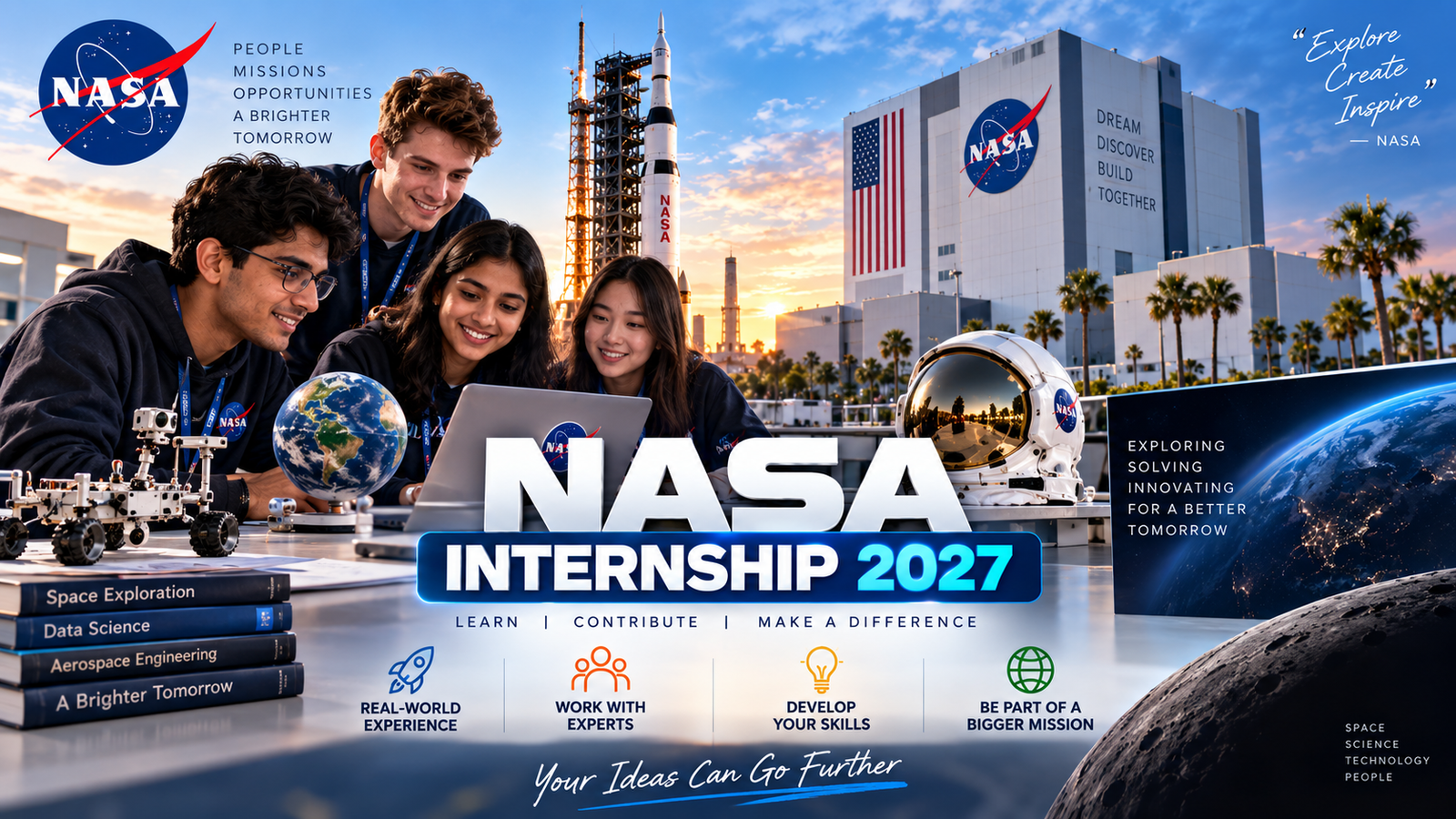
NASA Internship 2027
If you are a student interested in space, science, engineering, technology or research, the NASA Internship 2027 program could be an excellent way to gain practical experience before graduation.
NASA offers student opportunities through different programs, including the Office of STEM Engagement, commonly known as OSTEM, and the Pathways Internship Program. Both programs provide students with professional exposure, but their structure, duration and career outcomes are different.
The Spring 2027 application cycle is especially important because NASA has already announced the upcoming deadlines. The Spring 2027 OSTEM application deadline is September 14, 2026, at 11:59 p.m. ET. NASA has also published deadlines for the Summer and Fall 2027 sessions.
This guide explains the important details students should know before applying, including eligibility, deadlines, stipend information, available fields, application steps and the difference between OSTEM and Pathways.
NASA Internship 2027 – Quick Details
| Detail | Information |
|---|---|
| Organization | NASA |
| Main Programs | OSTEM and Pathways |
| Internship Year | 2027 |
| Spring OSTEM Deadline | September 14, 2026 |
| Summer OSTEM Deadline | February 26, 2027 |
| Fall OSTEM Deadline | May 21, 2027 |
| Internship Type | Paid |
| OSTEM Minimum Age | 16 years |
| OSTEM GPA | 3.0 on a 4.0 scale |
| Citizenship | U.S. citizen for standard OSTEM and Pathways programs |
| Fields | STEM and selected non-STEM areas |
| OSTEM Application | NASA STEM Gateway |
| Pathways Application | USAJOBS |
NASA states that OSTEM internships provide short-term, hands-on experience on real agency projects. Students work with NASA mentors and develop technical as well as professional skills.
What Is the NASA Internship 2027 Program?
The NASA Internship 2027 program is not a single job opening. It includes different projects, academic fields, NASA centers and internship sessions.
Through the OSTEM program, students can work on projects connected to science, technology, aeronautics and space exploration. The purpose is to help students understand how professional teams work and how academic knowledge is applied to real problems.
The experience can be useful for students who want to explore careers in engineering, computer science, research, mathematics, physical sciences or other related areas.
NASA also offers opportunities for selected non-STEM majors. Therefore, students should not assume that every NASA internship is limited to aerospace or engineering students. The available projects and their individual requirements should be checked before applying.
NASA OSTEM Internship 2027
OSTEM stands for the Office of STEM Engagement. These internships are designed for college-level students who want short-term, project-based experience at NASA.
OSTEM internships are generally available during three sessions:
- Spring
- Summer
- Fall
NASA says interns work under the guidance of mentors and contribute to real projects. The program can help students build their resume, improve career readiness and understand the expectations of a professional workplace.
Depending on the project, students may find opportunities related to:
- Computer science
- Engineering
- Mathematics
- Physical sciences
- Data analysis
- Research
- Information technology
- Earth science
- Business and communication
- Other professional fields
The exact responsibilities depend on the project. A student should therefore select opportunities based on their academic background and interests rather than applying only because the NASA name is attractive.
NASA Internship 2027 Application Deadlines
NASA has published the following OSTEM deadlines for 2027:
| Session | Application Deadline |
|---|---|
| Spring 2027 | September 14, 2026, at 11:59 p.m. ET |
| Summer 2027 | February 26, 2027, at 11:59 p.m. ET |
| Fall 2027 | May 21, 2027, at 11:59 p.m. ET |
These deadlines are listed on NASA’s official internship programs page.
Students applying for Spring 2027 should not wait until the final day. Resume updates, academic details and project information should be prepared in advance because incomplete information can delay the application process.
If the Spring session is missed, students can still check the Summer and Fall 2027 opportunities when their application windows open.
NASA Internship Eligibility 2027
The eligibility requirements depend on the program and the specific opportunity. For the standard OSTEM program, NASA lists the following requirements:
- Applicant must be a U.S. citizen
- Applicant must be at least 16 years old at the time of application
- Applicant must have a cumulative GPA of at least 3.0 on a 4.0 scale
- Applicant must be enrolled in a certificate or degree-granting program
- Applicant must attend an accredited U.S. educational institution
- Applicant’s field of study must match NASA’s available needs
NASA allows both undergraduate and graduate-level students to apply for eligible OSTEM opportunities.
Previous internship experience is not always necessary. Students who have completed coursework, academic projects, research or personal projects can still build a relevant application.
However, every project may include additional academic or technical requirements. Reading the full project description is therefore important.
Is NASA Internship 2027 Paid?
Yes. NASA describes OSTEM internships as paid opportunities.
However, NASA does not publish one fixed stipend amount for every intern. According to its official internship FAQ, the majority of interns receive a stipend based on their academic level and session duration.
This means the amount may vary from one student to another. Students should avoid relying on an estimated salary figure from an unofficial website unless it is clearly identified as an estimate.
The Pathways program follows a different pay structure. NASA states that Pathways starting pay depends on academic hours completed, position location and grade level. Eligible Pathways interns may also receive benefits similar to those available to permanent employees.
For accurate compensation information, applicants should check the specific internship announcement and official NASA information before making financial plans.
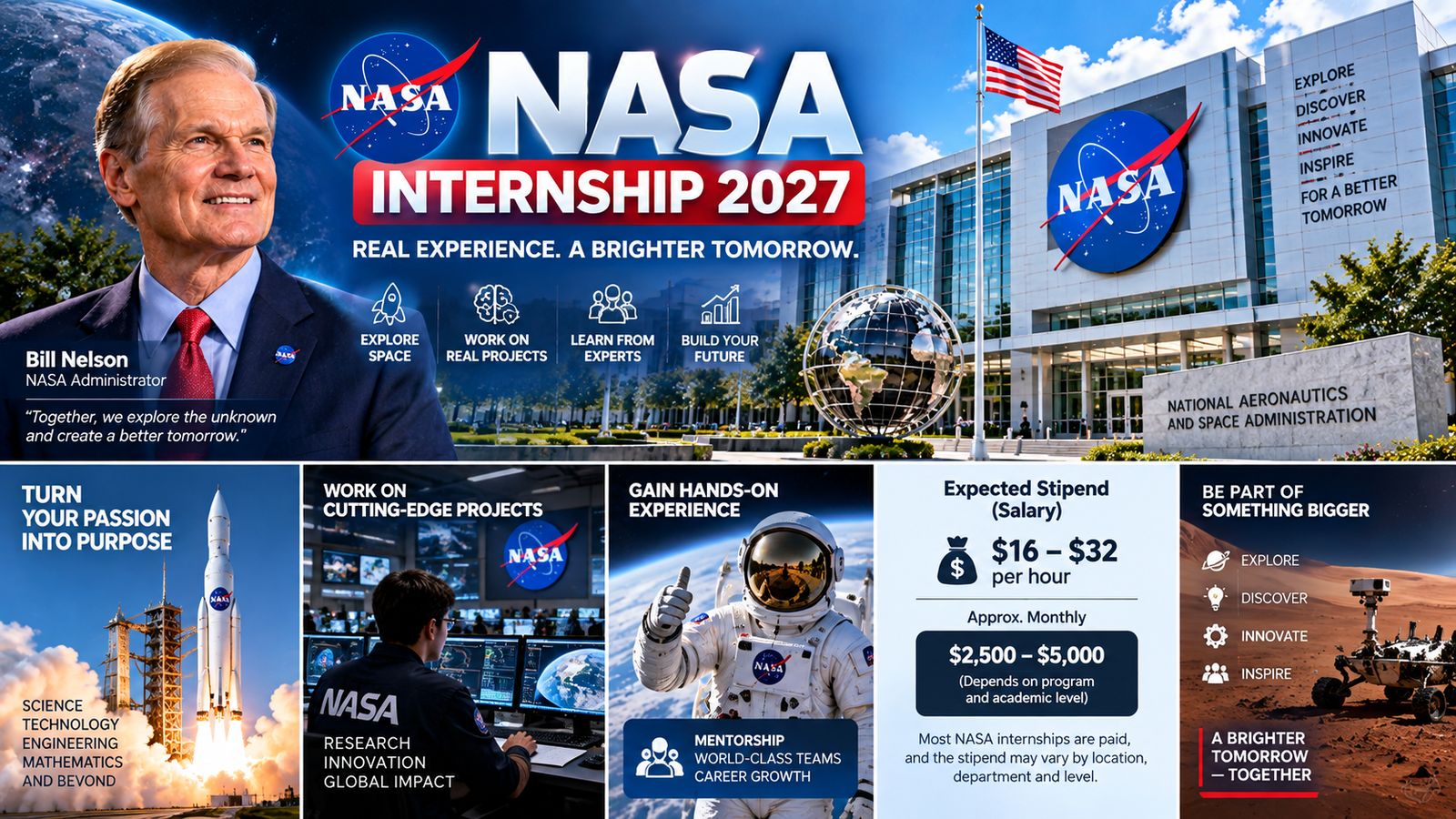
NASA Internship for Computer Science and Engineering Students
Computer science and engineering students may find several relevant areas within NASA’s work.
Modern space missions depend on software, data systems, research tools, simulations, computing infrastructure and engineering technologies. Because of this, students with technical skills can look for opportunities related to:
- Software development
- Data analysis
- Artificial intelligence
- Machine learning
- Robotics
- Scientific computing
- Engineering design
- Aerospace systems
- Research and testing
- Information technology
Students do not need to list every programming language they have studied. It is better to show how they used their skills in a real project.
For example, a computer science student could describe a Python project, a data analysis assignment or a software application. An engineering student could highlight a design project, simulation, laboratory activity or research experience.
NASA Pathways Internship 2027
NASA Internship 2027 is a valuable opportunity for students who want to gain practical experience, improve their technical skills and work on meaningful space-related projects. Selected interns can learn from experienced professionals, explore new ideas and build a strong foundation for their future careers in science, technology and engineering.
The Pathways Internship Program is different from OSTEM.
OSTEM is mainly a short-term, project-based learning opportunity. Pathways is a longer-term developmental program designed to prepare students for a career at NASA. It can also provide a direct route toward full-time federal employment after graduation for eligible participants.
NASA has announced that Spring 2027 Pathways applications will open on September 21, 2026, and close on September 25, 2026. The internships are scheduled to begin on January 25, 2027.
Spring 2027 Pathways opportunities include areas such as:
- Engineering
- Engineering technology
- Physical sciences
- Occupational safety and health
- Industrial hygiene
Students should check the available positions carefully because each vacancy may have different qualifying majors and location requirements.
OSTEM vs Pathways Internship
The main difference can be understood through the following comparison:
| OSTEM Internship | Pathways Internship |
|---|---|
| Short-term project-based experience | Multi-semester developmental experience |
| Usually connected to one internship session | Designed for longer-term career preparation |
| Application through NASA STEM Gateway | Application through USAJOBS |
| Minimum GPA generally 3.0 | Minimum GPA generally 2.9 |
| Three main sessions each year | Specific application windows |
| Focus on learning and project experience | Possible pathway to full-time NASA employment |
NASA describes OSTEM as a short-term hands-on experience, while Pathways is designed as a longer-term pipeline toward a NASA career.
Students should choose the program based on their academic stage and long-term goal.
How to Apply for NASA Internship 2027
Students interested in the NASA Internship 2027 program should begin by reviewing the official internship information and available project listings.
For OSTEM, applications are submitted through NASA’s internship system. For Pathways, students must follow the application instructions on the relevant USAJOBS vacancy.
Before applying, prepare the following:
- Updated resume
- Current academic details
- GPA information
- Degree and major information
- Relevant technical or professional skillsy
- Details of academic or personal projects
- Research experience, if available
- Any additional documents requested by the opportunity
NASA’s internship FAQ also confirms that students may apply for multiple internship opportunities, depending on the program and application rules.
How to Make Your Application Stronger
A strong NASA application should show evidence of your skills instead of only listing keywords.
For example, writing “Python, AI and Data Science” on a resume is less useful than explaining a project where you used Python to analyse data or build a model.
Try to answer three simple questions:
- What problem did you work on?
- What tools or methods did you use?
- What was the result?
Students should also demonstrate communication, teamwork, learning ability and problem-solving skills. NASA’s Pathways program specifically evaluates qualities such as attention to detail, flexibility, interpersonal skills, learning, self-management and technology application.
These qualities can be shown through college projects, research work, group assignments, volunteering or technical activities.
Can International Students Apply?
This is an important point for students outside the United States.
NASA’s standard OSTEM and Pathways programs list U.S. citizenship as an eligibility requirement. Therefore, international students should not assume that they can apply to the regular NASA internship programs.
NASA also provides information about separate international internship opportunities involving partner countries and organizations. These programs have their own rules and should be checked independently.
Always read the citizenship and eligibility section before preparing an application.
Students can check the official NASA Internship Programs page for eligibility, available opportunities and application updates.
Final Thoughts
The NASA Internship 2027 program can be a valuable opportunity for students who want practical experience in science, technology, engineering, research or space-related work.
The most immediate deadline is the Spring 2027 OSTEM deadline on September 14, 2026. Students interested in the longer-term Pathways program should also remember the September 21–25, 2026 application window.
NASA internships are paid, but the stipend is not one fixed amount for every student. The official information says that OSTEM stipend awards depend on academic level and session duration.
Before applying, select a project that matches your background, prepare a clear resume and explain your strongest work in simple language. A thoughtful application is more useful than a resume filled with unrelated skills.
Frequently Asked Questions
What is the NASA Internship 2027 deadline?
The Spring 2027 OSTEM application deadline is September 14, 2026, at 11:59 p.m. ET. The Summer 2027 deadline is February 26, 2027, and the Fall 2027 deadline is May 21, 2027.
Is NASA Internship 2027 paid?
Yes. NASA describes OSTEM internships as paid opportunities. The stipend depends on academic level and session duration.
What GPA is required for NASA OSTEM?
NASA lists a minimum cumulative GPA of 3.0 on a 4.0 scale for OSTEM applicants.
What is the difference between OSTEM and Pathways?
OSTEM is a short-term, project-based internship. Pathways is a multi-semester program designed to prepare students for a career at NASA and may lead to full-time employment after graduation.
Can international students apply for NASA internships?
The standard OSTEM and Pathways programs require U.S. citizenship. Separate international opportunities may have different eligibility rules.
When will NASA Pathways Spring 2027 applications open?
Spring 2027 Pathways applications are scheduled to open on September 21, 2026, and close on September 25, 2026.
Where can students apply?
OSTEM applications are submitted through NASA’s official internship system. Pathways applications are submitted through the relevant USAJOBS vacancy. Students should use NASA’s official program pages for the latest instructions.